We care about accessibility. If you struggle with colour blindness enable the high contrast mode to improve your experience.
Change the colour scheme of this website to make it easier to read
Fiona Clark March 2026.png

Image description

A photo of three people (in the middle is Fiona Clark), seated in front of a black cinema curtain. They are laughing together. There is an image of a bright rainbow behind them.

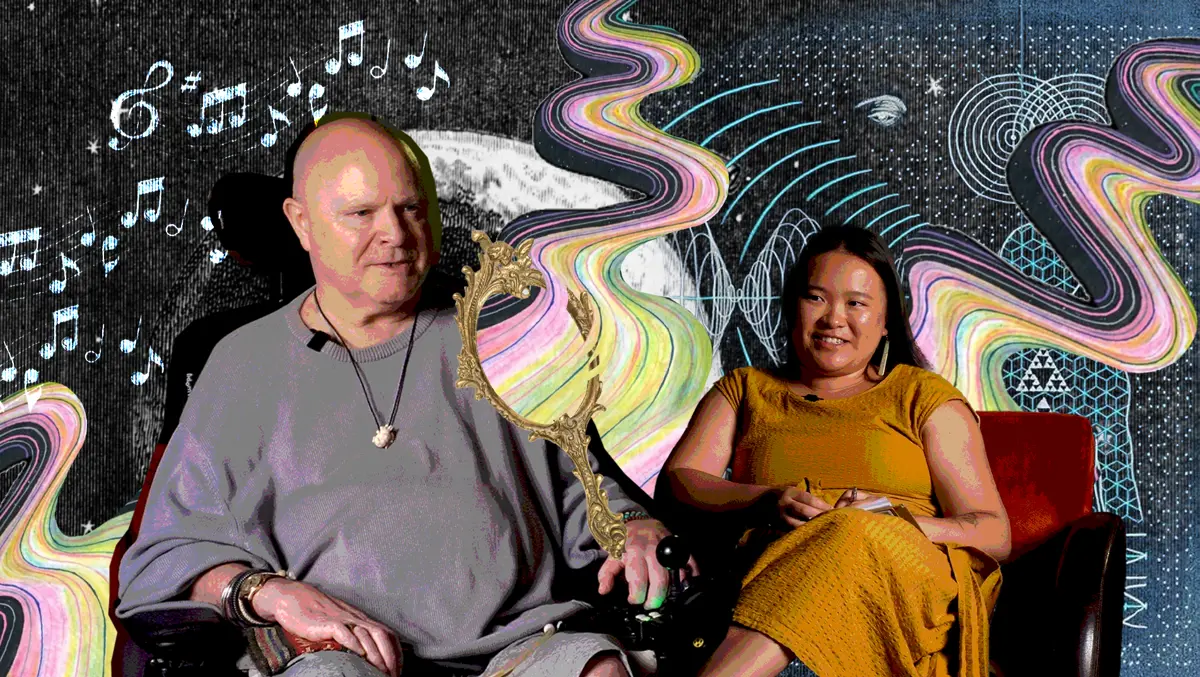
An evening with queer and disabled activist photographer, Fiona Clark

For Wellington Pride month, The D*List hosted a screening of the film ‘Fiona Clark: Unafraid’ and invited Fiona Clark to join us for a live Q&A after the film. This is a transcript of the Q+A.

  • Enormous thanks to Rainbow Wellington for their grant which enabled us to provide NZSL interpreters for this event. Thank you to our host venue, two/fiftyseven, and especially to Fiona Clark for her generosity with her time and wisdom. 

    Soph: Thank you everyone for coming tonight, and to Fiona for travelling down from New Plymouth this morning to be here! I'm Soph, my pronouns are they/them. I'm from The D*List, who is putting on this event. 

    That was the second time that I have seen that movie, but, Fiona, I imagine you've seen it quite a few times now?


    Fiona: Yeah, kia ora koutou. Yeah, I have. It was made quite a while ago, and it was made when my hair was short, so... 

    Soph: How was it watching it this time compared to watching it 5 years ago when it first came out? 

    Fiona: The most interesting thing is most people have died in that film, most of my friends. I’m the last one standing from the dance party series.
So that's quite sad. Even Georgina Beyer and Carmen, they've all gone. So that's pretty powerful. They’re going to show The Active Eye series that they stopped me showing in Auckland City this year. So those sorts of things… they weren’t happening when we started the film. You know, the Auckland Art Gallery had ignored that series of work and refused to show it again [note for clarity: the original exhibition was closed based on complaints of ‘obscenity’ in the 1970s]. But I waited 52 years and they're gonna show it! 

    Soph: That's great. 

    Fiona: I know.
And it's a show called Queer Aotearoa. That's pretty special. 

    Soph: So, after this film came out, do you feel like that changed things for you in terms of your career, or your perception of your career? Having seen it on screen in this way? 

    Fiona: No, I'm not really sure. I mean, I just keep working. I just keep taking photos, and doing what I do, because my practice is really what I call ‘longitudinal’. My niece has had a baby, so now I have a great nephew, and he’s 3 years old. So there's all sorts of things that come and…But it doesn't really change the way I live. Yeah, I get a bit overwhelmed sometimes because I think…I really want the photos to be good. So if the photos look good. I’m happy. 

    Soph: A few times in that film, people talk about the importance of what you were doing - documenting people's lives and documenting the community's lives at the time. Did you ever feel any sense of pressure in doing that, of, like, the importance of what you were doing, and that it might be moments of historical importance that you were capturing?

    Fiona: A lot of the early work in the 70s was really driven by an anger approach. Like, we’re here, we’re visible, you just accept it. These are good photos of the beauty in the community that we come from. So that was part of why I wanted to record it that way. Because to me, it's a reflection of myself, that's the community we have. 

    Soph: Yeah, and they're beautiful images and obviously still very treasured by a lot of people now, which is amazing. Do you have a moment from your career or a piece of work from your career that you're most proud of? 

    Fiona: I'm not really sure about that... I'm always working, like, I've got some shows coming up this year, and people want to re-show old work, so that's pretty good. I think it’s the continuation. Somebody's interested in another set of work from 1975. So that's pretty good. It just keeps going. And I think the idea of a longitudinal practice as an artist is the thing I'm probably most proud of, that I've continued that. And that's what I think is very valuable in a community when you're part of it, you know, I'm not going to abandon the ship. That’s what I think about, because my ship’s, you know, I've been sailing for a while. 

    Soph: Definitely. And that was something that a few people talked about as well in the film was the importance of relationships to you and your work, and how you have sustained relationships with so many of the people that you've photographed or worked with over the years. So you can certainly see those values playing out in your career and how other people perceive you as well. 

    I have a few other questions I could ask, but I would like to see if anyone else would like to ask any questions. I'm gonna just throw it to the audience, if you pop up your hand, you don't have to come up to the mic, you can just shout it from your seat, if you would like. 


    Community member 1: Kia ora Fiona, I wanted to know, whatever became of those two photos that mysteriously went missing, do you have any theories of where they went and ended up? 

    Fiona: Yeah. I mean, I was pretty annoyed because, you know, this is a major institution in New Zealand that just let something get lost. The police turned up to view the works and I think - this is my theory - is that the police thought they were big artworks. So the gallery, the Auckland City Gallery, took them out of the frames for the viewing at the director's office. So they were laid on a director's desk, a police officer came in and said, oh, well, they’re just photographs. But of course they didn't have any of the writing around them [note for clarity: additional comments from the queer community, people in the photographs, were written around the edges originally], which was what people were objecting to, but also the visibility of the trans and gay and lesbian community. Like this was visibility. The police were all, ‘so what?’.
And then that was the last the photographs were seen, they were seen on the director’s desk. And then when the crates turned up, when the exhibition travelled to the next venue, the crates were empty. So they went missing. 
But in those days, this was very pre-digital. You always had to supply a copy print for the catalogue, because there's a catalogue that goes with an exhibition. So I made copy prints. 

    So, in Auckland this year, the copy prints will be shown. You can duplicate things, and with digital, that’s even better. But yeah, I mean, someone told me once they'd been given to a collector in Australia...One day someone might turn up and say, here they are. But I think someone probably just disposed of them.
Then it was only a couple of years ago that the Auckland City Gallery apologised for that. Because the controversy was huge. I mean, being called degenerates publicly, you know. There was a church that preached a sermon about the degenerate photographer, you know, and this was in New Plymouth. 
I mean, I lived just out of New Plymouth at the time. That's where I live. But it was pretty bad. And so Tina always felt we needed a public apology. She just died a year ago, and one of my promises to her was, we'll get them back on the wall. And they will be seen again. So it sort of is...yeah, I don't think there's been another censorship of art in New Zealand that has that level of just, you know, throw it away and forget. But it is sad that nobody else in that set of photos is alive, that can come to the Auckland City Gallery in…I think the show is in July. I don't care who else is in the show, as long as we’re on the walls! Yeah. That’s quite a long answer!

    Community member 1: Well, I'm glad you got a big fat apology from Auckland Art Gallery. 

    Fiona: Yeah, it took a while. 
But, you know, they did apologise. 

    Community member 2: Seeing your work, it's a lot about memory and keeping memory. What piece of advice would you give to us in order to not forget, and to keep registering the memories of our communities? 

    Fiona: I just think it’s important to take photos of the community, of you know, everything. It doesn't matter what it is, whether it’s the kitchen, the layout, what's on the walls in the house - because that's very specific. You know, I’ll just generalise, the queer community…well you can walk into a house and go, yes. The gaydar is going. So those moments are part of what the memory is for me. If you've got the intuition, take the photo, or film it. That's my view. These days you can record stuff so easily, with a tripod, and go yeah, we’ll photograph that. Whether it's a lounge of friends, or whatever it is, it's really important. Because that's what I've done (laughs).
I've been in a lot of lounges and houses and, you know, all the places that people hang out. 

    Community member 3: I was just wondering whether there was a camera that you might’ve used, throughout your whole career and even now. Is there a particular camera?

    Fiona: Yeah, that old Laika M3. It's the 1951 version. Because, Laika used to label the editions, when they came out. And that's sturdy. That’s an analogue film camera but I still really like using it, but I have a nice little Lumix in my bag. I still quite like it. I don't sell cameras, I don’t get rid of my cameras, they’re like part of my furniture. 

    Ella (D*List kaimahi): I had a question. Is your webcam of Mount Taranaki still going? [note for clarity: Fiona Clark runs a constant livestream of Mount Taranaki which you can find here.]

    Fiona: Yeah, it is. I had a few problems with that not working well, so I replaced it, and the replacement is not as good as the other one. The other one, the older camera is still workable. I've got to rebuild the tower a bit because it's a bit dangerous. The wood has been up there so long. Yeah, it does still run, and you can get daily photos, and you can view the mountain. It is sort of an art time project as well, because it takes time lapses, so I've got years and years’ worth. I'm not sure what I'll do with them, but it doesn't matter. You know, it's a very beautiful ancestral mountain and it's incredibly important when you live in a place that that's what that holds.

    Community member 4: I was really struck watching that film, about your optimism or tenacity or like, not sinking into despair or anything and just keep going. I don't know, I don't have a very specific question about that, but I just wonder if there's anything you can share with us about that?

    Fiona: Yeah, I really don’t like missing out on stuff. The accident did change a lot, I thought, I'm going back to Taranaki to live. But I just really don't want to miss out stuff. So I've got that always in the back of my mind, and I've always got the fact that no matter what someone suggests to me, I’ll listen.
Sometimes, because you have a camera, people will say, ‘you should take a photo of such and such’, ‘you should be…’. I was like, okay, then I probably should be. So, I try and listen.

    I don't really like being sick or ill, I really want to be healthy. Age is a bit of a crippler, but it's okay. I mean, I'm not very happy with the way the world's going. Oh my god. Who wants to go to Europe! No, we’ll be staying home. But, there's still lots of positive things and the community has come so far. When you think about HIV, it was a death sentence, and how many of the years there were no drugs. All the achievements that we've had, and even someone like celebrating Carmen Rupe in Wellington, that’s wonderful, you know? And it might just be a traffic light at the moment or a t-shirt. But that's pretty extraordinary to be able to live through that. Well, that's how I feel. You've got other stuff you’ll live through. Sorry. [laughs]

    Community member 5: Speaking of that other stuff, because we're living through at the moment. We're seeing quite a rise in anti-trans rhetoric online, and it's sort of feeding into our communities.
You see a lot of your work is around shifting narrative, and almost using art and photography as a protest. For those here who are battling those sorts of rhetoric at the moment, in our work or in our lives, is there any advice you can give in terms of what we can do? Is that a big question? 

    Fiona: It's a big question. I mean, things like just celebrating Pride.
Taranaki’s got a pride celebration, I'm a part of the pride team, a trustee in Taranaki now, and we're having a pride week. We’re doing 2 drag shows, but we're doing lots of community events and that's really important. But also if you've got good images and good artwork to put out there, there are spaces. It’s just keeping that visibility going really and just not sitting down, standing up and saying, yep, we're been here a long time. You know, we really do whakapapa to our community. That’s how I feel about, I mean, photographing Carmen Rupe was pretty extraordinary, and then doing her 70th birthday party, that was, oh, my God. It was fun. Those moments are so important and to leave the legacy of the pictures from that time, whether it's the pride events in Wellington, some really good images to leave, that’s really, really important, because institutions have changed. But in the past, we didn't have those images. We didn't have a picture of Carmen. But we do now. So those things are really important to shift in institutions and museums. Well, that's how that's my version anyway, because when I grew up, Auckland City Gallery, you’d go and see just, seven blokes from London. That was it, you know? Like, you just didn’t have any other cultural narrative, nothing. So it's quite good, but, just, it's a bit of a ride. 


    Soph: I have a question. Do you feel like there are still barriers in the art world now, to telling queer stories or disability stories? Obviously not to the extent, potentially, that you faced in the 70s, but do you feel like there are still barriers in the art world in that sense? 

    Fiona: Yeah, I think there are, I think, they're still uncomfortable. Of course, there is, yeah. You can pick it up quite quickly, I can, if someone comes to visit me. They’re just not interested. And you do see that. And, even within galleries doing the Queer Aotearoa show in Auckland. When I went through art school, there were quite a few queer artists and some of them probably haven't - won’t - be recognised in that show. 
And they were good, their work was good, but they never got recognised because they were queer and very queer. And they may get mentioned in a publication, that will be it. But we'll find, maybe in 10 years' time, somebody will show those works because that visibility’s still, you know, quite hard for people to manage. 

    Soph: Well, are there any particular artists in New Zealand that you feel like are deserving more attention than they’ve had? 

    Fiona: There's quite an odd set of early gay artists that were quite interesting, that I knew through Art Elam, and there was some women as well. So, yeah, there are, and I'm sure that people will write about them more. They were probably considered outrageous, and of course, lecturers didn't have to worry because homosexuality was illegal.
So, goodbye, the content wasn't considered serious. That’s the way that they used to say it. It wasn't ‘serious’. But, every now and then someone comes up with someone else [note for clarity: unrecognised artists] and it feels they've discovered somebody. Well, okay, they've always been here. 

    Soph: Are there any more questions from anyone else? 

    Community member 6:
What brings you joy today? Apart from working and growing beans?

    Fiona: Connecting with the community I live in. You know, it’s great having a pride family in Taranaki. And that's only happened in the last 5 years, maybe. And we're building a Pride archive, in New Plymouth now. So that's pretty extraordinary to have an archive. Because we have a rich history, and the Puke Arika, the local museum, will accept those stories. That's sort of happiness at the moment. Yeah. And also just continuing to work. I feel very lucky sometimes.

    Soph: Any more questions? I think the aircon just turned off, so it got very silent. [laughs]

    Community member 7: I just wondered what your experience of the queer community in a place like Taranaki has been versus what you experienced when you were living in cities? And obviously you were drawn back by family, it sounds like, but what else has added to your experience on wanting to be where you are? I also live in Taranaki as well, by the way.
And it's awesome to see the archive project kick off and yeah, the visible community, but I guess you have seen that over time. 

    Fiona: Yeah, it's changed a lot. I went back there because of that controversy, I mean, it was just like running home and hiding. It was pretty brutal. But the problem for me was that I thought I was really good. Like ‘these are good photos, how dare they!’. So, it was like a retreat. That's what really happened, and it was a big factory [note for clarity: the former dairy factory that Fiona now lives in], and it was so cheap to buy, it was peanuts. I mean, they basically wanted to give it away because it was sort of, well, not derelict, but pretty run down. I can't remember what the question was. 

    Community member 7: Your experience in a rural place. 


    Fiona: Yeah. Well, I sort of ignore most... I mean, I'm in a farming area. The neighbour’s actually up to 1700 cows now. And buying more land and milking more cows. So I sort of ignore that part of it and I connect with a community that I enjoy being with. But the new pride community is pretty wonderful, actually. There's some really good key people, which is great. Yeah, so, but that has changed a lot. I mean, Tertius [note for clarity: an old friend from the 1970s] left New Plymouth to go to the Adelaide Arts Festival. He never came back, basically. And he'd had enough.
I mean, his wonderful silk outfits. People did not cope. And people used to expect that we would turn up places and it was like ‘we’. There wasn't any sense of people living individual lives either, as gay people. That was the strangest thing. People don't expect that now. But when you turned up with someone else at an event, people would immediately think you're a couple. Like, what? Okay. Meanwhile, Tertius is checking the room and I'm like, ‘no’. He goes ‘yes’. It was very funny anyway. Lots of little early secrets of that time. 

    But yeah, that's changed quite a lot, so people don't have that expectation. Like Abby says in the film, people don't really see me as serious about what I do. But, you know, that's fine. And they're good photos. It's good work.
And that's the thing that I always think you've got to believe in it, because otherwise I could have just left the work. Or not followed up with Carmen because I first met her in ‘74 and then ‘75 was the drag ball, then I'd been to Wellington a couple of times, and I just kept that going because I thought that that was good. And her response was fantastic.
That was the other thing. So it was that family sense as well. 

    Soph: Okay.
I think we can wrap up if we're finished with the questions. Is there anything else you want to say? 

    Fiona: No, but thanks for having me… It’s come a long way. Since, you know, art school, and being told various things... So, it's really great. To have family, and all of that. It's really amazing. I'm [in my] early 70s, but I've got lots of friends who've died. So they haven't lived through that yet. And that's quite special to live through another era of that positive sense of family within a queer community. It's pretty wonderful.  

    Soph: I think it's been pretty special to watch this movie, and have you here as part of Wellington Pride, and yeah, really grateful that you made the trip down here this morning. Yeah, thank you so much. And thank you everyone for coming. 

    Fiona: Thank you. 

    This transcript has had minor edits for clarity and brevity.

Related