We care about accessibility. If you struggle with colour blindness enable the high contrast mode to improve your experience.
Change the colour scheme of this website to make it easier to read
It 02 Noise 1

Image description

Jo Randerson in a cloaked costume surrounded by stars and bright swirls. There are MRI scans of a human head in the background against a background with shades of pink, blue and purple. 
Design: Mili Ghosh

Access as a Creative Opportunity: An interview with the creators of Speed is Emotional

Coming to Aotearoa New Zealand Festival of the Arts, Speed is Emotional places an emphasis on accessibility with audio description, relaxed performances and integrated NZSL.

  • Access as a Creative Opportunity: An interview with the creators of Speed is Emotional
    Helen Vivienne Fletcher
    0:00
    |
    0:00
  • New theatre show Speed Is Emotional is set to stage its Wellington debut as part of the Aotearoa New Zealand Festival of the Arts in March.

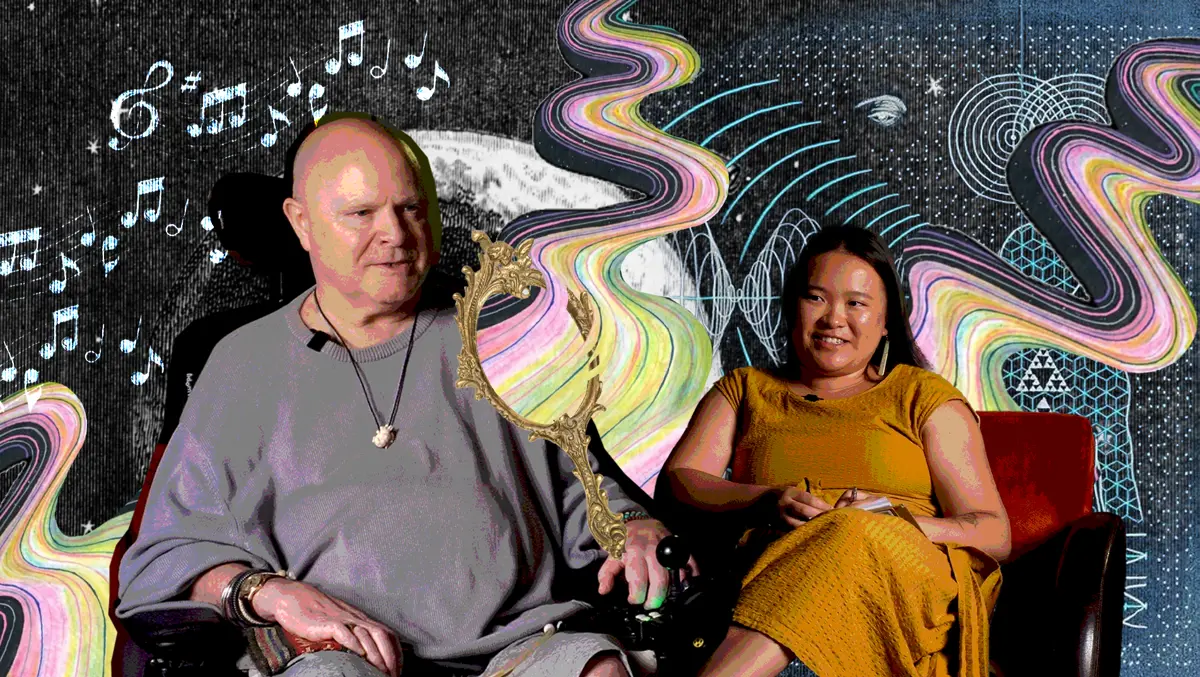
    Speed is Emotional tells Jo Randerson’s story of receiving an ADHD diagnosis in their 40’s, after their teenage son was diagnosed. The show proudly places an emphasis on accessibility with audio description, all relaxed performances, and integrated NZSL performances by Deaf performer Pollyanna Ferguson.

    Rāhera Turner and Laura Haughey from Equal Voices, an award-winning Deaf and hearing international theatre company based in the Waikato, joined Jo and Pollyanna as an integral part of the team, providing Deaf consultancy and physical dramaturgy.

    Helen Vivienne Fletcher: Tell us about the show and the inspiration behind it.

    Jo: I needed to make a show to help me make sense not only of this condition, but my life leading up to that point, my journey as an artist and why I was finding particular life tasks challenging. It’s a funny and surprising show, humour helps me access the more difficult parts of the story: it softens the tensions and helps me move through the painful parts. Speed Is Emotional is a blend of many different kinds of storytelling (sound/movement/words/expression) – that’s how my brain works, I never want to do just one thing at a time. 

    Pollyanna: I was invited into the process because Rāhera always noticed how fast-paced I am, always on the go, and thought that energy and way of being would connect well with Jo’s process. From there, the work became a shared exploration of how ADHD shows up differently for different people, across Deaf and hearing experiences.

    Helen: Accessibility has been an integral part of this production. How has this influenced the show’s creation and rehearsal process?

    Jo: We spent a lot of time preparing for our audience and ensuring that this was accessible for them, but we forgot to make our rehearsal process accessible. We quickly learned that we couldn’t shortcut this process and we needed to slow down and check what we all needed. Clear communication got us through this and understanding that our neurodiversities all look different, there’s no one-size-fits-all. 

Image description: Jo Randerson performs in Speed is Emotional. 

  • Hero Image Landscape
  • Pollyanna: Because NZSL is integrated and all performances are relaxed, we had to think differently about rhythm, pacing, and communication in rehearsal. It created space for flexibility and honesty, and allowed everyone to work in ways that suit how their brains function. That openness influenced how the story was built and how we rehearsed, making the process more human and responsive rather than rigid.

    Rāhera: NZSL integration, audio description, and relaxed performance principles were treated as creative elements rather than add-ons […] As a result, accessibility strengthened the artistic language of the work and supported a more inclusive and sustainable creative process.

    Helen: Pollyanna, you’re performing alongside Jo on the NZSL integrated performance nights. Can you tell us a bit more about what that means, and how you and Jo have been working together?

    Pollyanna: We work together to tell the story physically, visually, and emotionally. […] We’ve built trust in each other’s timing, presence, and impulses, so the performance feels shared rather than split between languages.

    This show matters to me because I’m not onstage as an interpreter — I’m there as a performer and a storyteller. My presence allows Deaf audiences to see their own experiences reflected, especially around ADHD traits like time blindness and constant movement. Working alongside a professional hearing actor, my role shows that Deaf stories belong at the centre of theatre-making, not the margins. 

    Helen: Have there been any surprising moments, challenges or things you’ve learned during the rehearsal process?

    Pollyanna: One of the biggest learnings has been how differently ADHD can be experienced and expressed, especially across Deaf and hearing worlds. A challenge was finding ways to honour those differences without simplifying them. 

    Rāhera: One of the most valuable learnings was how much time and trust it takes to build genuinely shared processes between Deaf and hearing artists. While this presented challenges […] it also opened up unexpected creative possibilities. The rehearsal room became a space for listening, adjustment, and mutual learning, reinforcing the importance of flexibility and respect when accessibility is embedded as a core part of the work.

  • Clear communication got us through this and understanding that our neurodiversities all look different, there’s no one-size-fits-all. 

    Pollyanna Ferguson

  • Jo: A particular challenge was how to address the show’s focus on music, which has been a lifesaver for me. We’d get to bits in the show where music plays, and Pollyanna would start signing to the audience, something like, ‘Whatever, they’re playing instruments now, it doesn’t mean anything to me,’ which was beautifully funny, and true, and a great reminder that different audiences will be taking different things away from the show. 

    Helen: What’s one piece of advice you would give to people wanting to create accessible theatre?

    Laura: Instead of considering access as something that needs adding on, consider the creative possibilities that exploring access gives you as artists. Artists are uniquely placed to engage and explore creative potential when making accessible work – and working with this idea from the get-go means it becomes part of the artistry.

    Pollyanna: Make sure Deaf people are involved from the very beginning through to the end. Don’t bring them in only to translate — involve them in shaping the story, the structure, and the creative decisions.

    Rāhera: Deaf-led practice recognises Deaf artists as skilled professionals with creative expertise and lived knowledge, not as last-minute consultants brought in to translate a hearing-centred process. This means involving Deaf artists early, trusting their leadership, and supporting collaborative work that meets professional theatre standards. 

    Jo: You don’t have to do it all at once, view each season as a chance to learn more. Sometimes we can get stuck in an all or nothing attitude, and feel if we’re not achieving every goal then it’s not worth doing any of it. But every bit will lead to more accessibility in the long run, so just keep going and get better at it each time.

    Final thoughts…

    Rāhera: I hope this work encourages people to think differently about access — not as a barrier, but as a creative opportunity. When accessibility is treated with care and intention, it can open up new ways of storytelling and connection. 


    Speed is Emotional makes its Wellington premiere March 11 – 28 at Circa Theatre as part of the Aotearoa New Zealand Festival of the Arts Access Programme. 

    Running from February 24 – March 15, the ANZFA Access Programme features 15 shows with a range of accessible options including audio description, NZSL interpreted performances, relaxed performances, and sighted guides. Full details can be found on the ANZFA Access Page.

    Speed is Emotional will also be touring Whangārei and Hamilton between February 17 and 22, for more information about these seasons, please visit the Barbarian Productions website.

Related